ALL ABOUT TODAY

Navigate History & Make Others Navigate your History. History-science-technology-trends-Today

Explore MilkyWay

Today In History

This Day in History

Today's Birthday

In the News

Recent Comments

HITS

Archives

Recent Posts

Subscribe Now: google

Add to Google Reader or Homepage

21-July-1658 Aurangzeb celebrated his being the emperor of Mugal Empire at Delhi. He was informally enthroned.

21-July-1883 Star Theatre was opened in Calcutta.

21-July-1891 Jairamdas Doulatram, great leader, journalist and freedom fighter, was born at Karachi.

21-July-1906 W.C. Bonerjee, first President of Indian National Congress, passed away.

21-July-1907 Gulam Mohamad Bakshi, former Prime Minister Jammu and Kashmir, was born.

21-July-1911 Umashankar Jethalal Joshi, famous Gujarati poet, Hindi writer and educationist, was born at Bamna in Gujarat.

21-July-1930 Anand Bakshi, famous lyrisist, was born.

21-July-1934 Chandrakant Gulabrao Borde, cricket batsman (55 Tests for India 1959-67), was born in Pune.

21-July-1935 Establishment 'Mumabi Marathi Sahitya Sangh'.

21-July-1936 Vasantrao Vishnu Limye, senior journalist and President of 'Ratnagiri District Parishad', was born.

21-July-1947 Indian Constitution Assembly accepted the tricolour flag as its National Flag. This flag is with three equal horizontal stripes of Saffron (Sacrifice), White (Truth) and Green

(Prosperity) and a Chakra is superimposed on white (Dharma Chakra on the capitol of Ashoka's Pillar at Sarnath) in blue colour having 24 spokes. The ratio of the width to length is two to three.

21-July-1962 Passenger Train and Freight Train collided near Dumraon killing 69 persons.

21-July-1963 Kashi Vidyapeeth was given recognisation as University.

21-July-1975 Hindi Post Guards was established by Government.

21-July-1977 K.S. Hegde elected Lok Sabha Speaker.

21-July-1977 Neelam Sanjiva Reddi was elected as the President of India.

21-July-1977 Bhudevchandra Basu, famous animal expert, passed away.

21-July-1984 Terrorists breach Bhakra canal in Punjab.

21-July-1988 Indian National Satellite (INSAT-1C) launched. This is operational multi-purpose communication and meteorology satellite. It served for only one and a half years. It was launched by European Ariane launch vehicle Ariane-3.

21-July-1993 Jayalalitha ends fast, Centre to set up a committee; Karnataka rejects the proposal.

21-July-1994 The Supreme Court declares that SC/ST will lose status on migration to other states.

21-July-1995 Sajjad Husain, famous film music director, passed away.

21-July-1999 Bansi Lal, Haryana Chief Minister, quits before seeking a trust vote; and rebels form a separate party.

21-July-1999 The Janata Dal splits under Deve Gowda and Sharad Yadav. The latter group to support NDA.

21-July-2000 A. B. Vajpayee, Prime Minister, announces a special fund for population projects with the Planning Commission providing seed money of Rs. 100 crores. He was addressing the maiden meeting of the National Population Commission.

Armstrong walks on moon


"That's one small step for man, one giant leap for mankind."


At 10:56 p.m. EDT, American astronaut Neil Armstrong, 240,000 miles from Earth, speaks these words to more than a billion people listening at home: "That's one small step for man, one giant leap for mankind." Stepping off the lunar landing module Eagle, Armstrong became the first human to walk on the surface of the moon.

The American effort to send astronauts to the moon has its origins in a famous appeal President John F. Kennedy made to a special joint session of Congress on May 25, 1961.

In 1966, after five years of work by an international team of scientists and engineers, the National Aeronautics and Space Administration (NASA) conducted the first unmanned Apollo mission, testing the structural integrity of the proposed launch vehicle and spacecraft combination. Then, on January 27, 1967, tragedy struck at Kennedy Space Center in Cape Canaveral, Florida, when a fire broke out during a manned launch-pad test of the Apollo spacecraft and Saturn rocket. Three astronauts were killed in the fire.

Despite the setback, NASA and its thousands of employees forged ahead, and in October 1968, Apollo 7, the first manned Apollo mission, orbited Earth and successfully tested many of the sophisticated systems needed to conduct a moon journey and landing. In December of the same year, Apollo 8 took three astronauts to the dark side of the moon and back, and in March 1969 Apollo 9 tested the lunar module for the first time while in Earth orbit. Then in May, the three astronauts of Apollo 10 took the first complete Apollo spacecraft around the moon in a dry run for the scheduled July landing mission.

At 9:32 a.m. on July 16, with the world watching, Apollo 11 took off from Kennedy Space Center with astronauts Neil Armstrong, Edwin Aldrin Jr., and Michael Collins aboard. Armstrong, a 38-year-old civilian research pilot, was the commander of the mission. After traveling 240,000 miles in 76 hours, Apollo 11 entered into a lunar orbit on July 19. The next day, at 1:46 p.m., the lunar module Eagle, manned by Armstrong and Aldrin, separated from the command module, where Collins remained. Two hours later, the Eagle began its descent to the lunar surface, and at 4:18 p.m. the craft touched down on the southwestern edge of the Sea of Tranquility. Armstrong immediately radioed to Mission Control in Houston, Texas, a famous message: "The Eagle has landed."


Landing Of APOLLO 11


At 10:39 p.m., five hours ahead of the original schedule, Armstrong opened the hatch of the lunar module. As he made his way down the lunar module's ladder, a television camera attached to the craft recorded his progress and beamed the signal back to Earth, where hundreds of millions watched in great anticipation. At 10:56 p.m., Armstrong spoke his famous quote, which he later contended was slightly garbled by his microphone and meant to be "that's one small step for a man, one giant leap for mankind." He then planted his left foot on the gray, powdery surface, took a cautious step forward, and humanity had walked on the moon.

"Buzz" Aldrin joined him on the moon's surface at 11:11 p.m., and together they took photographs of the terrain, planted a U.S. flag, ran a few simple scientific tests, and spoke with President Richard M. Nixon via Houston. By 1:11 a.m. on July 21, both astronauts were back in the lunar module and the hatch was closed. The two men slept that night on the surface of the moon, and at 1:54 p.m. the Eagle began its ascent back to the command module. Among the items left on the surface of the moon was a plaque that read: "Here men from the planet Earth first set foot on the moon--July 1969 A.D--We came in peace for all mankind."

At 5:35 p.m., Armstrong and Aldrin successfully docked and rejoined Collins, and at 12:56 a.m. on July 22 Apollo 11 began its journey home, safely splashing down in the Pacific Ocean at 12:51 p.m. on July 24.

There would be five more successful lunar landing missions, and one unplanned lunar swing-by, Apollo 13. The last men to walk on the moon, astronauts Eugene Cernan and Harrison Schmitt of the Apollo 17 mission, left the lunar surface on December 14, 1972. The Apollo program was a costly and labor intensive endeavor, involving an estimated 400,000 engineers, technicians, and scientists, and costing $24 billion (close to $100 billion in today's dollars). The expense was justified by Kennedy's 1961 mandate to beat the Soviets to the moon, and after the feat was accomplished ongoing missions lost their viability.

July 20, 1951

King of Jordan assassinated

While entering a mosque in the Jordanian sector of east Jerusalem, King Abdullah of Jordan is assassinated by a Palestinian nationalist.

Abdullah was a member of the Hashemites, an Arab dynasty said to be directly descended from the Prophet Muhammad. During World War I, with British support, Abdullah led an Arab revolt against Turkish rule in Jordan. In 1921, the British made him the emir of Transjordan, and with Jordanian independence in 1946 he became the country's monarch. Two years later, he led his armies against the newly declared state of Israel, and Jordan annexed east Jerusalem along with the portions of Palestine now known as the West Bank. In 1951, his efforts to create an Arab federation under Hashemite rule ended when he was assassinated in Jerusalem.

After a brief sojourn on the Jordanian throne, Abdullah's son was declared mentally unfit to rule and was replaced by Abdullah's grandson, Hussein bin Talal. King Hussein ruled until he died in 1999; he was succeeded by his son, Abdullah.

July 20, 1976

Viking 1 lands on Mars


On the seventh anniversary of the Apollo 11 lunar landing, the Viking 1 lander, an unmanned U.S. planetary probe, becomes the first spacecraft to successfully land on the surface of Mars.

Viking 1 was launched on August 20, 1975, and arrived at Mars on June 19, 1976. The first month of its orbit was devoted to imaging the surface to find appropriate landing sites. On July 20, 1976, the Viking 1 lander separated from the orbiter, touched down on the Chryse Planitia region of Mars, and sent back the first close-up photographs of the rust-colored Martian surface.

In September 1976, Viking 2--launched only three weeks after Viking 1--entered into orbit around Mars, where it assisted Viking 1 in imaging the surface and also sent down a lander. During the dual Viking missions, the two orbiters imaged the entire surface of Mars at a resolution of 150 to 300 meters, and the two landers sent back more than 1,400 images of the planet's surface.

July 20, 1894

Errett Lobban Cord is born

Errett Lobban Cord was born in Warrensburg, Missouri, on this day in 1894. Cord moved to Los Angeles while he was in high school and remained there after his graduation, starting a number of car dealerships. His prowess as a salesman led him to pursue bigger goals and to look for a way to invest the $100,000 he had managed to save in a few years of work. "Then I started looking around," he said, "I wanted to do something with that $100,000."

Cord found the struggling Auburn Automobile Company in Auburn, Indiana, a company on its last legs, having completed only 175 cars in 1923. Cord convinced Ralph Bard, head of a Chicago group that had purchased Auburn, to take him on as general manager at no cost, with the stipulation that if Cord turned the company around he would be allowed to purchase controlling interest. He launched a sales blitz, rapidly clearing out Auburn's inventory and enabling it to show a profit.

By 1926, Cord was company president and the following year the company established dividends at $4 a share and eight percent in stock. Cord then launched an aggressive business strategy, purchasing companies in many manufacturing fields and trading his stock on the New York Stock Exchange. He acquired Duesenberg in order to add a luxury car line to his Auburn cars. Sound stock management allowed Cord to expand his operations during the Depression while many other companies were merely struggling to survive.

Cord established an empire consisting of Auburn, Duesenberg, Stinson Aircraft, Lycoming Motors, Limousine Body, and a number of engineering plants. He placed his new acquisitions in a holding company called the Cord Corporation. In 1933, he added New York Shipbuilding and Checker Cab to his conglomerate. During the 1930s, sales of Cord's cars stumbled. Their heavy price tags could not be born by the tightening market. Nevertheless, during the late 1930s, Cord's company produced some of the finest classic cars in automotive history, but Cord's empire fell as precipitously as it had risen. He and Morris Markin, President of Checker, were investigated by the Securities and Exchange Commission for stock manipulation. In one case Cord and Markin had purchased 70,000 shares of Checker at $7. Their action created the illusion of great activity in their stock, driving the price up. Markin and Cord unloaded their shares at an average price of $59 per share. Both men denied the charges, but neither contested a court injunction preventing them from further impropriety. The same day of the verdict Cord sold all of his interest in the Cord Corporation for $2.6 million.

Cord died from cancer, in Reno, Nev., in 1974.

July 20, 1948

Truman issues peacetime draft

President Harry S. Truman institutes a military draft with a proclamation calling for nearly 10 million men to register for military service within the next two months. Truman's action came during increasing Cold War tensions with the Soviet Union.

Following World War II, the United States moved quickly to demobilize the vast military it had constructed during the conflict. During the war, more than 16 million men and women served in the U.S. military; when the war ended in August 1945, the American people demanded rapid demobilization. By 1948, less than 550,000 men remained in the U.S. Army. This rapid decline in the size of America's military concerned U.S. government officials, who believed that a confrontation with the Soviet Union was imminent. During the years following World War II, relations between the Russians and Americans deteriorated rapidly. In 1947, the president issued the Truman Doctrine, which provided aid to Greece and Turkey to oppose communist subversion. In that same year, Secretary of State George C. Marshall warned that Western Europe was on the brink of political and economic chaos that would leave it defenseless against communist aggression; the following year, Congress approved billions of dollars in financial assistance to the beleaguered nations. In June 1948, the Soviets cut all land traffic into the U.S.-British-French zones of occupation in West Berlin. The United States responded with the Berlin Airlift, in which tons of food and supplies were flown in to sustain the population of the besieged city. In light of these events, many Americans believed that actual combat with the Soviet Union was not far away. In response to this threat, President Truman announced on July 20, 1948, that the United States was re-instituting the draft and issued a proclamation requiring nearly 10 million men to register for military service in the next two months.

Truman's decision underlined the urgency of his administration's concern about a possible military confrontation with the Soviet Union. It also brought home to the American people in concrete terms the possibility that the Cold War could, at any moment, become an actual war. In 1950, possibility turned to reality when the United States entered the Korean War, and the size of America's armed forces once again increased dramatically.

July 20, 1977

Second great flood hits Johnstown

A flash flood hits Johnstown, Pennsylvania, on this day in 1977, killing 84 people and causing millions of dollars in damages. This flood came 88 years after the infamous Great Flood of 1889 that killed more than 2,000 people in Johnstown. As they had in the first flood, the dams in the Conemaugh Valley failed, bringing disaster to the town.

The flood occurred when an extraordinary amount of rain came down in the Conemaugh Valley in a short period of time. Nearly 12 inches were measured in 10 hours. The National Weather Service later estimated that this amount of rain in that location should happen less than once every 1,000 years.

The largest dam that burst was at Laurel Run. This 10-year-old earthen dam held back 100 million gallons of water. Despite having a 42-foot-high spillway, the dam failed and the resulting flood devastated the town of Tanneryville. Five other dams in the area also burst, releasing another 30 million gallons of water over the landscape.

The failure of the dams came as a big surprise. Johnstown had constructed an entire system designed to completely eliminate the flood risk. In addition, regular inspections had turned up no defects. Still, the dams were no match for the thunderstorm that stalled over the area on July 20.

In addition to the 84 people who lost their lives to the flood, $300 million in damages were suffered and hundreds of people lost their homes. President Carter declared the region a federal disaster area and the National Guard was sent to assist in the relief efforts. Despite millions spent to rehabilitate the Johnstown area, the economy never recovered. The city’s population decreased nearly 15 percent in the aftermath of the flood, as people moved away to rebuild their lives elsewhere.

July 20, 1869

Mark Twain's book The Innocents Abroad is published

Mark Twain's book The Innocents Abroad is published, recounting his journey to Europe and the Holy Land in 1869. The book became a bestseller.

Samuel Langhorne Clemens, who adopted the pseudonym Mark Twain, was born in Hannibal, Missouri. Apprenticed to a printer at age 13, he later worked for his older brother, who established the Hannibal Journal.

In 1857, Clemens became a steamboat pilot's apprentice, earned his license, and piloted his own boats for two years. During his time as a pilot, he picked up the term "Mark Twain," a boatman's call noting that the river was only two fathoms deep, the minimum depth for safe navigation. When Clemens returned to writing in 1861, working for the Virginia City Territorial Enterprise, he wrote a humorous travel letter signed by "Mark Twain" and continued to use the pseudonym for nearly 50 years.

In 1866, Clemens went to Hawaii as a correspondent for the Sacramento Union. Later, he traveled the world writing accounts for papers in California and New York, which became The Innocents Abroad.

In 1870, Clemens married the daughter of a wealthy New York coal merchant and settled in Hartford, Connecticut, where he continued to write travel accounts and lecture. In1875, his novel Tom Sawyer was published, followed by Life on the Mississippi (1883). Bad investments left Clemens bankrupt after the publication of his masterpiece Huckleberry Finn in 1885, but he won back his financial standing with his next three books. In 1903, he and his family moved to Italy, where his wife died. Her death left him sad and bitter, and his work, while still humorous, grew distinctly darker. He died in 1910.

July 20, 1894

Pullman strike turns deadly

During the summer of 1894, the Pullman Palace Car Company was embroiled in what proved to be one of the most bitter strikes in American history. The strike was a direct response to company chief George Pullman and his hardball tactics, most notably his decision in the midst of the Depression of 1893 to preserve profits by slashing wages and hiking up workers' rents. A band of frustrated employees implored Pullman to ease rents and restore wages; Pullman responded by firing three of the workers. In May, the workers fired back at their avaricious boss by calling a strike. Backed by the organizational muscle of Eugene Debs and the mighty American Railway Union (ARU), the workers touched off a round of sympathy strikes and boycotts that effectively crippled the Chicago-based company. However, Pullman had has own network of powerful allies, including other rail honchos and a number government officials. In hopes of enlisting the aid of the federal military, Pullman and his cronies convinced the government that the strikes and boycotts were inhibiting the delivery of America's mail. Though Pullman's cars didn't carry any mail, the scheme proved effective: in early July, the government banned the boycotts and swiftly shipped troops to Chicago. Fighting broke out shortly after the government forces hit the scene; by the time the militia left Chicago on July 20, the "war" between the troops and the strikers had left thirty-four men dead. But, the damage had already been done to the Pullman strikers: their ranks and clout had been depleted, and, when American Federation of Labor chief Samuel Gompers' refusal to lend them any substantial support, the rail workers were forced to capitulate to management. In the wake of the settlement, many of the strikers were barred from working in the rail industry.

Source : www.History.com

Gerd Binnig

Born 20 Jul 1947
German-born physicist who co-invented the scanning tunneling microscope with Heinrich Rohrer. They shared the 1986 Nobel Prize for Physics with Ernst Ruska, who designed the first electron microscope. This instrument is not a true microscope ( i.e. an instrument that gives a direct image of an object) since it is based on the principle that the structure of a surface can be studied using a stylus that scans the surface at a fixed distance from it. Vertical adjustment of the stylus is controlled by means of what is termed the tunnel effect - hence the name of the instrument.

Robert D. Maurer
Born 20 Jul 1924
American research physicist, who with his colleagues at Corning Glass Works, Dr. Donald B. Keck and Dr. Peter Schultz invented fused silica optical waveguide - optical fiber. This was a breakthrough creating a revolution in telecommunications, capable of carrying 65,000 times more information than conventional copper wire. In 1970, Maurer, Keck, and Schultz solved a problem that had previously stumped scientists around the world. They designed and produced the first optical fiber with optical losses low enough for wide use in telecommunications. The light loss was limited to 20 decibels per kilometer (at least one percent of the light entering a fiber remains after traveling one kilometer). He retired in 1989.

Tadeus Reichstein Born 20 Jul 1897; died 1 Aug 1996.
Polish-born Swiss chemist who identified the steroid hormones of the adrenal cortex and studied their structure and biological effects. For his role in this discovery, he shared the Nobel Prize for Physiology or Medicine in 1950 with Philip S. Hench and Edward C. Kendall.

John Reith
Born 20 Jul 1889
John Charles Walsham Reith, 1st Baron Reith, first Director-General of BBC (1927-38) died in Stonehaven, Grampian. As the BBC's founding father, he looked westwards in the 1920s to America's unregulated, commercial radio, and then east to the fledgling Soviet Union's rigidly controlled state system. Reith's vision was of an independent British broadcaster able to educate, inform and entertain. the whole nation, free from political interference and commercial pressure. In doing that he believed it would enrich the intellectual and cultural life of the nation. It is in this spirit that the BBC annually invites a leading figure to deliver a series of Reith lectures in his memory using the medium of radio to advance greater public understanding of their field.

Tadeus Reichstein
Born 20 July 1897
Swiss chemist who, with Philip S. Hench and Edward C. Kendall, received the Nobel Prize for Physiology or Medicine in 1950 for his discoveries concerning hormones of the adrenal cortex, their structure and biological effects. With his co-workers, Reichstein accomplished the first isolation of four active hormones from the adrenal cortex, the first synthesis of one of them, the proof of the steroid nature of said hormones, and numerous details on the structure and properties of these important bodies. This made synthesis possible, leading to the creation of new medications.

Errett Lobban Cord

Born 20 Jul 1894; died 1974.
U.S. automobile manufacturer, advocate of front-wheel-drive vehicles. Cord, still in his twenties when he arrived at the Auburn Automobile Company, had a talent for seeking and hiring young, innovative minds, full of drive and ambition. Cord was a brilliant, complex industrialist who helped personal and public transportation come of age. He is best known today for Auburn, Cord and Duesenberg automobiles, Cord's greatest talent may have been his unparalleled ability to construct an automotive empire durable enough to thrive during the darkest years of the Great Depression. Photo: 1929 Cord L-29 Sedan, America's first front-drive production car. Built by the Auburn Automobile Company, Auburn, Indiana.

Alberto Santos-Dumont
Born 20 Jul 1873; died 23 Jul 1932.
Alberto Santos-Dumont was a Brazilian aviation pioneer, deemed the Father of Aviation by his countrymen. At the age of 18, Santos-Dumont was sent by his father to Paris where he devoted his time to the study of chemistry, physics, astronomy and mechanics. His first spherical balloon made its first ascension in Paris on 4 July 1898. He developed steering capabilities, and in his sixth dirigible on 19 Oct 1901 won the "Deutsch Prize," awarded to the balloonist who circumnavigated the Eiffel Tower. He turned to heavier-than-air flight, and on 12 Nov 1906 his 14-BIS airplane flew a distance of 220 meters, height of 6 m. and speed of 37 km/h. to win the "Archdecon Prize." In 1909, he produced his famous "Demoiselle" or "Grasshopper" monoplanes, the forerunners of the modern light plane.

J. J. Sederholm
Born 20 Jul 1863; died 26 June 1934
Jakob Johannes Sederholm was a pioneering geologist who studied the Precambrian rocks of Finland. He was appointed geologist to the Geological Commission of Finland in 1888, where later he became its director (1893 to 1933). The Precambrian period ran from 3.96 billion to 570 million years ago. Precambrian rocks, called sheilds can only be found today in Africa, Europe, and North America. Not much of these rocks can be found, but the ones that are display evidence of having been altered by intense metamorphosism. The minerals that the sheilds are made of are generally granite, schist, or gneiss.

Georg Elias Müller
Born 20 Jul 1850; died Dec 1934.
Georg Elias Nathanael Müller was a German psychologist whose research work encompassed four principal areas: psychophysical method, memory, thought psychology, and color perception theory. The psychophysics anticipated the color theory, which was founded on Hering. The memory work led into the thought psychology, which was founded on Herbart and Külpe. Whereas earlier in his career his published works lacked original data, he sharpened his approach and became known as the methodologist of psychological experimentation. The experiments carried out in his lab were the gold standard of experimental results. He was directed one of the major centres of psychological research at the University of Göttingen (1881-1921).«

Julius Cohnheim
Born 20 July 1839; died 1884
Julius Friedrich Cohnheim was a pioneer of experimental pathology who helped determine the morbid changes that occur in animal tissue affected by inflammation, tuberculosis, and other disease states. He demonstrated that inflammation was an active dynamic process. He was the first to scientifically classify tumors the way we still do today (ex. carcinomas, fibroma, sarcoma). Cohnheim proposed the first great theory of cancer's origin, the theory of embryonal rests. He thought more germ cells are produced with a developing embryo than are needed to form any given part and that cancer's development involves this excess material.

Sir Thomas Clifford Allbutt

Born 20 July 1836; died 22 Feb 1925.
English physician, the inventor of the short clinical thermometer. The need for suitable equipment to measure the progress of a fever by temperature at the bedside was solved in 1866 when Allbutt invented the conveniently portable six-inch clinical thermometer, able to take a temperature in five minutes. It replaced a foot-long model that required 20 minutes to determine a patient's temperature. His investigations also led to the improved treatment of arterial diseases when he proved than angina is caused by the narrowing of the coronary artery. Image: Allbutt, detail of a portrait by Sir William Orpen (EB) Sir William

Bowman
Born 20 Jul 1816; died 1892.
(1st Baronet) was an English surgeon and histologist who obtained a European reputation for medical research long before he was thirty years of age. He described (1842) the histologic structure of the nephron, the functional unit of the kidney, where the process of of urine takes place as a by-product of blood filtration that is carried on in the kidney. The "Bowman's capsule" of the kidney carries his name. The kidney contains millions of very tiny sacs called Bowman's capsules that filter blood to produce urine. He also made important discoveries concerning the structure and function of the eye and of striated muscle. He collaborated with Todd in writing The Physiological Anatomy.

Sir Richard Owen
Born 20 Jul 1804; died 18 Dec 1892.
English anatomist and paleontologist who is remembered for his contributions to the study of fossil animals and for his strong opposition to the views of Charles Darwin. He created the word "Dinosaur" meaning "terrible reptile" (1842). Owen synthesized French anatomical work, especially from Cuvier and Geoffroy, with German transcendental anatomy. He gave us many of the terms still used today in anatomy and evolutionary biology, including "homology". In 1856, he was appointed Superintendent of the British Museum (Natural History). Image: Detail from portrait by William Holman Hunt. Sir James Kay-

Shuttleworth

Born 20 Jul 1804
(1st Baronet, original surname Kay) was a physician, public-health reformer, and chief founder of the English system of publicly financed elementary education. A medical graduate of Edinburgh University, he was also a cholera doctor in Manchester, a pioneer social scientist and town planner, an assistant Poor Law commissioner, the manager of a large landed estate (Gawthorpe Hall), a would-be politician and a novelist. His surname, Kay, changed in 1842 upon marriage to Janet Shuttleworth. His turbulent political, personal and family life is fascinating in itself and, in addition, sheds light on many aspects of nineteenth century social history.

Five years ago: Gen. John Abizaid, the top commander of coalition forces in Iraq, predicted that resistance to U.S. forces in Iraq would grow in coming months as progress was made in creating a new government to replace the dictatorial regime of Saddam Hussein. President Bush welcomed Italian Premier Silvio Berlusconi to his Texas ranch for a two-day visit. Ben Curtis, an unknown PGA Tour rookie in his first major championship, won the British Open.

One year ago: President Bush signed an executive order prohibiting cruel and inhuman treatment, including humiliation or denigration of religious beliefs, in the detention and interrogation of terrorism suspects. Tammy Faye Messner, who as Tammy Faye Bakker helped her husband, Jim, build a multimillion-dollar evangelism empire, then watched it collapse in disgrace, died at age 65 near Kansas City, Mo.

1991 - The five permanent members of U.N. Security Council tell Iraq's ambassador his country must swiftly disclose extent of its nuclear program or face serious consequences.

2000 - The long-delayed International Space Station's service module is lifted off into orbit.

1810

Colombia declared independence from Spain.

1881

Fugitive Sioux Indian leader Sitting Bull surrendered to federal troops.

1985

Treasure hunters found the Spanish galleon Nuestra Senora de Atocha, which sank off the coast of Key West, Fla., in 1622 during a hurricane. The ship contained over 400 million in coins and silver ingots.

1944 Adolf Hitler was only slightly wounded when a bomb planted by would-be assassins exploded at the German leader's Rastenburg headquarters.

1960: Ceylon chooses world's first woman PM

Sirimavo Bandaranaike makes history when she becomes the first-ever female head of government.

1999 After 38 years at the bottom of the Atlantic, astronaut Gus Grissom's Liberty Bell 7 Mercury capsule was lifted to the surface.

514:

Hormisdas becomes pope

July 18, 1940

FDR nominated for unprecedented third term
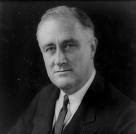
Franklin Delano Roosevelt

On this day in 1940, Franklin Delano Roosevelt, who first took office in 1933 as America's 32nd president, is nominated for an unprecedented third term. Roosevelt, a Democrat, would eventually be elected to a record four terms in office, the only U.S. president to serve more than two terms.

Roosevelt was born January 30, 1882, in Hyde Park, New York, and went on to serve as a New York state senator from 1911 to 1913, assistant secretary of the Navy from 1913 to 1920 and governor of New York from 1929 to 1932. In 1932, he defeated incumbent Herbert Hoover to be elected president for the first time. During his first term, Roosevelt enacted his New Deal social programs, which were aimed at lifting America out of the Great Depression. In 1936, he won his second term in office by defeating Kansas governor Alf Landon in a landslide.

On July 18, 1940, Roosevelt was nominated for a third presidential term at the Democratic Party convention in Chicago. The president received some criticism for running again because there was an unwritten rule in American politics that no U.S. president should serve more than two terms. The custom dated back to the country's first president, George Washington, who in 1796 declined to run for a third term in office. Nevertheless, Roosevelt believed it was his duty to continue serving and lead his country through the mounting crisis in Europe, where Hitler's Nazi Germany was on the rise. The president went on to defeat Republican Wendell Wilkie in the general election, and his third term in office was dominated by America's involvement in World War II.

In 1944, with the war still in progress, Roosevelt defeated New York governor Thomas Dewey for a fourth term in office. However, the president was unable to complete the full term. On April 12, 1945, Roosevelt, who had suffered from various health problems for years, died at age 63 in Warm Springs, Georgia. He was succeeded by Vice President Harry S. Truman.
On March 21, 1947, Congress passed the 22nd Amendment to the U.S. Constitution, which stated that no person could be elected to the office of president more than twice. The amendment was ratified by the required number of states in 1951.

July 18, 1986

Video of Titanic wreckage released
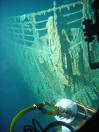
Titanic

On this day in 1986, new close-up videotapes of the sunken ocean liner Titanic are released to the public. Taken on the first manned expedition to the wreck, the videotapes are stunning in their clarity and detail, showing one of the ship's majestic grand staircases and a coral-covered chandelier swinging slowly in the ocean current.

At the time of its launch, the RMS Titanic was the largest ocean liner ever built, measuring nearly 900 feet long and 150 feet from its water line to its highest beam. It was considered unsinkable owing both to its vast size and its special construction. On its maiden voyage, the Titanic carried more than 2,200 people, including several of the world's most rich and famous. Its collision with an iceberg and subsequent sinking in the icy waters of the North Atlantic resulted in the death of some 1,500 people, many of whom could have been saved if the ship had carried a sufficient number of lifeboats.

It was not until 73 years later, in 1985, that the Titanic wreck was discovered. Marine geologist Robert Ballard, in conjunction with Jean-Louis Michel of the Institute of Research for the Exploitation of the Sea (IFREMER), located the remains of the Titanic 350 miles southeast of Newfoundland, 13,000 feet down on the ocean floor. Ballard, who was from Massachusetts' Woods Hole Oceanographic Institute, had the help of the U.S. Navy, which supplied him with Argo, a high resolution sonar device and submersible photographic sled.

Ballard's discovery caused a great stir among the public, and touched off a new era in underwater exploration and scientific research, especially around the topic of the Titanic. The following year, Ballard returned to the wreck, this time to dive down to the bottom in a submersible craft called Alvin and acquire photo footage of the ghost ship. Ballard was accompanied by Ralph Hollis, the Alvin's pilot, and Mark Bowen, who piloted Jason, Jr., a robotic submarine, or "swimming eyeball," used to explore the interior of the liner. Two miles beneath the surface, the explorers found, frozen in time, trappings of life aboard the Titanic, including a wood-burning stove and unopened champagne bottles being readied for a toast. Jason, Jr. also found the ship's safes, but left them as they lay: It was decided that the Titanic expedition would leave the ship's debris undisturbed on the ocean floor.

Even after several years of visiting the wreckage, not a trace of human remains has been found. Like other soft, degradable materials such as wood and carpet, human body parts were most likely scavenged by sea creatures not long after the ship's sinking.

July 18, 1792

Naval hero John Paul Jones dies in Paris
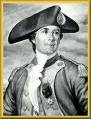
Naval hero John Paul Jones

On this day in 1792, the Revolutionary War naval hero John Paul Jones dies in his Paris apartment, where he was still awaiting a commission as the United States consul to Algiers. Commander Jones, remembered as one of the most daring and successful naval commanders of the American Revolution, was born in Scotland, on July 6, 1747. He became an apprentice to a merchant at 13 and soon went to sea, traveling first to the West Indies and then to North America as a young man. In Virginia at the onset of the American Revolution, Jones sided with the Patriots and received a commission as a first lieutenant in the Continental Navy on December 7, 1775. After departing from Brest, Jones successfully executed raids on two forts in Englands Whitehaven Harbor, despite a disgruntled crew more interested in gain than honor. Jones then continued to his home territory of Kirkcudbright Bay, Scotland, where he intended to abduct the earl of Selkirk and then exchange him for American sailors held captive by Britain. Although he did not find the earl at home, Jones crew was able to steal all his silver, including his wifes teapot, still containing her breakfast tea. From Scotland, Jones sailed across the Irish Sea to Carrickfergus, where his Ranger captured the HMS Drake after delivering fatal wounds to the British ships captain and lieutenant. In September 1779, Jones fought one of the fiercest battles in naval history when he led the USS Bonhomme Richard frigate, named for Benjamin Franklin, in an engagement with the 50-gun British warship HMS Serapis. After the Bonhomme Richard was struck, it began taking on water and caught fire. When the British captain of the Serapis ordered Jones to surrender, he famously replied I have not yet begun to fight! A few hours later, the captain and crew of the Serapis admitted defeat and Jones took command of the British ship.

One of the greatest naval commanders in history, Jones is remembered as a Father of the American Navy, along with fellow Revolutionary War hero Commodore John Barry. At the conclusion of the American War for Independence, Jones briefly served Empress Catherine II of Russia, before retiring to Paris. John Paul Jones is buried in a crypt at the U.S. Naval Academy Chapel in Annapolis, Maryland, where a Marine honor guard stands at attention in his honor whenever the crypt is open to the public.

July 18, 1948

"The Maestro" makes Formula One debut
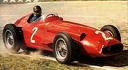
The Maestro makes Formula One debut

Juan Manuel Fangio, a.k.a. "the Maestro," made his Formula One debut finishing 12th at the Grand Prix de l'ACF in France. Fangio was 37 years old at the start of his first Formula One race, but his late appearance onto the racing scene did not diminish his impact. Born to an Italian immigrant family outside of Buenos Aires, Argentina, Fangio learned to race on the death-trap tracks of Argentina for little reward. Finally, his excellence was recognized by Argentine dictator Juan Peron, who agreed to sponsor Fangio's racing career. Formula One Grand Prix racing began in 1950, and Fangio took second place in the World Driver's Championship driving for Alpha Romeo. The next year he won. A crash kept him out of the circuit for the next two years, but in 1954, he switched to the Mercedes team and won his first of four consecutive World Driver's Championships. He is the only man to ever have won five titles. Fangio was known for his spectacular technical ability and for his demure manner. He spoke always with the quiet confidence that comes from a specific talent. Said Fangio, "great drivers can do their best times in two or three laps of a circuit, while others take 10, 20, or 30." Fangio's greatest achievement came in his last full season at the German Grand Prix in Nurburgring. He needed to fend off Ferrrari's driving team of Hawthorne and Collins to wrap up his fifth world title. Fangio started the race with half-full tanks, intending to build an insurmountable lead in his lighter car. When he pitted, however, the Ferrari's thundered by, stretching to a 56-second lead. The chances looked dim for the Maestro. Gradually, though, he pulled himself back into the race. On three consecutive laps he bettered the track record for the 14.2 mile Nordeschlifer ("North Ring") by an incredible 12 seconds. Fangio was racing faster than his qualifying times recorded on an empty course. Hand over fist he pulled the Ferrari cars in, their team managers urging them on in disbelief. Fangio stated, "I believe that on that day in 1957 I finally managed to master the Nurburgring, making those laps in the dark on those curves where I had never before had the courage to push things so far." After a few races in 1958, Fangio retired. The mild-mannered Argentine reflected that since he retired, the only racers to have approached his mastery of the sport were Jim Clark and Ayrton Senna. Both men died in their cars.

Juan Manuel Fangio died on July 17, 1995, and was buried in Balcarce, Argentina.

July 18, 1945

Charges of communists in the U.S. Army raised

In testimony before the House Military Affairs subcommittee, the subcommittee's chief counsel, H. Ralph Burton, charges that 16 officers and non-commissioned officers in the U.S. Army have pasts that "reflect communism." The charges, issued nearly 10 years before Senator Joseph McCarthy would make similar accusations, were hotly denied by the U.S. Army and government.

By July 1945, with the war in Europe having ended just two months before, Cold War animosities between the United States and the Soviet Union were already beginning to arise. The two nations, allies against Hitler during World War II, were dividing over issues such as the postwar fate of Germany and the Soviet occupation of Eastern Europe. One aspect of the growing tensions between the Soviet Union and the United States involved charges that communist agents were at work in various sectors of American society, such as Hollywood and the federal government. In July 1945, House Military Affairs subcommittee chief counsel H. Ralph Burton testified that his investigations revealed at least 16 officers and non-commissioned officers in the U.S. Army had communist backgrounds. As evidence, Burton cited the fact that some of the men had contributed writings to radical journals such as New Masses. In addition, some of the men had served in the Abraham Lincoln Brigade, a volunteer fighting force that battled against the fascist forces of Franco in Spain during that nation's civil war in the 1930s. The U.S. Army quickly fired back, declaring that its own investigation revealed that none of the men named by Burton "was disaffected or disloyal." Whatever activities prior to their military service the men might have engaged in, "the real criterion always remains: Is the individual at the present time whole-heartedly loyal to the United States?" In the celebration that accompanied the U.S. victory over Japan less than three weeks after Burton's testimony, the charges against the U.S. Army were forgotten.

Burton's charges are of interest, however, coming nearly 10 years prior to Senator Joseph McCarthy's similar accusations against the U.S. Army in 1954. In the latter case, McCarthy was completely disgraced during his hearings into communism in the Army. The 1945 accusations indicate that McCarthy was not the creator of the so-called Red Scare that swept the nation after World War II. Indeed, even before World War II came to an end, charges of communist infiltration of the U.S. government and military were being issued.

July 18, 1984

Twenty-one people are shot to death at McDonald's

James Oliver Huberty opens fire in a crowded McDonald's restaurant in San Ysidro, California, killing 21 people and wounding 19 others with several automatic weapons. Minutes earlier, Huberty had left home, telling his wife, "I'm going hunting . . . hunting for humans."

Huberty, who had a history of mental problems, lost his job in Ohio the previous year. He brought his family to San Diego and worked as a security guard until he was fired again, a month before the shootings. His wife claimed that Huberty called a mental health clinic to make an appointment for counseling but was never called back. Huberty had a love affair with guns, keeping a small arsenal in his bedroom. Neighbors described him as very angry.
Bringing several of these guns, including a 9mm automatic pistol and semiautomatic rifle, into the McDonald's two miles from the Mexican border, Huberty demanded that the 45 patrons get on the floor. He then walked around the restaurant, calmly shooting people. He killed 20 in the first ten minutes, including four who tried to escape. There were so many shots fired that the police first assumed that there was more than one gunman inside. Firing at a fire truck that responded to the scene, Huberty also grazed one firefighter with a bullet.

An hour after the shooting began, an employee managed to escape through the basement and inform the SWAT team that Huberty was alone and without hostages. With this information, sharpshooters were told to "take him out." A marksman sent a shot through Huberty's chest and killed him. After making sure that he was dead, police finally entered the restaurant. San Diego Police Chief William Kolender said, "I hope to God I never see such a thing again."

July 18, 64

Nero’s Rome burns
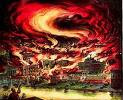
Neros Rome burns

The great fire of Rome breaks out and destroys much of the city on this day in the year 64. Despite the well-known stories, there is no evidence that the Roman emperor, Nero, either started the fire or played the fiddle while it burned. Still, he did use the disaster to further his political agenda.

The fire began in the slums of a district south of the legendary Palatine Hill. The area’s homes burned very quickly and the fire spread north, fueled by high winds. During the chaos of the fire, there were reports of heavy looting. The fire ended up raging out of control for nearly three days. Three of Rome’s 14 districts were completely wiped out; only four were untouched by the tremendous conflagration. Hundreds of people died in the fire and many thousands were left homeless.

Although popular legend holds that Emperor Nero fiddled while the city burned, this account is wrong on several accounts. First, the fiddle did not even exist at the time. Instead, Nero was well known for his talent on the lyre; he often composed his own music. More importantly, Nero was actually 35 miles away in Antium when the fire broke out. In fact, he let his palace be used as a shelter.

Legend has long blamed Nero for a couple of reasons. Nero did not like the aesthetics of the city and used the devastation of the fire in order to change much of it and institute new building codes throughout the city. Nero also used the fire to clamp down on the growing influence of Christians in Rome. He arrested, tortured and executed hundreds of Christians on the pretext that they had something to do with the fire.

July 18, 1947

Truman signs second Presidential Succession Act
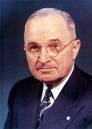
President Harry S. Truman

On this day in 1947, President Harry S. Truman signs the Presidential Succession Act. This act revised an older succession act that was passed in 1792 during George Washington’s first term.

The original succession act designated the Senate president pro tempore as the first in line to succeed the president should he and the vice president die unexpectedly while in office. If he for some reason could not take over the duties, the speaker of the house was placed next in the line of succession. In 1886, during Grover Cleveland’s administration, Congress removed both the Senate president and the speaker of the house from the line of succession. From that time until 1947, two cabinet officials, (their order in line depended on the order in which the agencies were created) became the next in line to succeed a president should the vice president also become incapacitated or die. The decision was controversial. Many members of Congress felt that those in a position to succeed the president should be elected officials and not, as cabinet members were, political appointees, thereby giving both Republican and Democratic parties a chance at controlling the White House.

In 1945, then-Vice President Truman assumed the presidency after Franklin Roosevelt died of a stroke during his fourth term. As president, Truman advanced the view that the speaker of the house, as an elected official, should be next in line to be president after the vice president. On July 18, 1947, he signed an act that resurrected the original 1792 law, but placed the speaker ahead of the Senate president pro tempore in the hierarchy. Truman’s critics at the time claimed that the president did so because he had a close friendship with then-Speaker Sam Rayburn, and a less congenial relationship with Kenneth McKellar, the president pro tempore.

Fortunately for the country, there has never been an instance in which the presidency has had to pass to anyone other than the vice president.

July 18, 1996

Johnson makes bid for Prince

On this day in 1996, erstwhile car seating manufacturer Johnson Controls, Inc. made a bid to become the king of automotive interiors by acquiring Prince Holding Corporation. For the regal sum of $1.35 billion, Johnson snapped up a company that, for the past thirty years, had strove to "surprise and delight" drivers and passengers. Towards that end, Prince pioneered the use of electronics in car interiors; one of the company's main claims to fame was grafting lighted mirrors on to car's sun visors. This and other luxury-minded novelties made Prince an attractive partner for Johnson. Indeed, as company honcho James Keyes noted, Johnson had been looking to expand beyond the world of automotive seating "systems." Viewed in purely fiscal terms, the addition of Prince and its lucrative roster of products promised to fatten Johnson's already healthy coffers. In a statement released shortly after the deal, the companies estimated that their combined sales muscle would skyrocket Johnson's annual sales from $850 million to $6 billion.

July 18, 1925

Mein Kampf is published
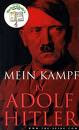
Mein Kampf

On this day in 1925, Volume One of Adolf Hitler's philosophical autobiography, Mein Kampf, is published. It was a blueprint of his agenda for a Third Reich and a clear exposition of the nightmare that will envelope Europe from 1939 to 1945. The book sold a total of 9,473 copies in its first year.

Hitler began composing his tome while sitting in Landsberg prison, convicted of treason for his role in the infamous Beer Hall Putsch in which he and his minions attempted to stage a coup and grasp control of the government in Bavaria. It ended in disaster, with some allies deserting and others falling into the hands of the authorities. Hitler was sentenced to five years' imprisonment (he would serve only nine months). His time in the old fortress at Landsberg was hardly brutal; he was allowed guests and gifts, and was treated as something of a cult hero. He decided to put his leisure time to good use and so began dictating Volume One of his opus magnus to Rudolph Hess, a loyal member of the German National Socialist Party and fellow revolutionary.

The first part of Mein Kampf, subtitled "A Reckoning," is a 400-plus page diatribe on the problems besetting Germany-the French, who wished to dismember Germany; the lack of lebesraum, "living space," and the need to expand east into Russia; and the baleful influence of "mongrel" races. For Hitler, the state was not an economic entity, but a racial one. Racial purity was an absolute necessity for a revitalized Germany. "[F]or men do not perish as the result of lost wars, but by the loss...of pure blood."

As for leadership, Hitler's Third Reich would mimic the Prussian ideal of absolute authoritarian rule. "There must be no majority decisions, but only responsible persons.... Surely every man will have advisers...but the decision will be made by one man."

So there it was: War with France, war with Russia, the elimination of "impure" races, and absolute dictatorship. Hitler laid out his political agenda a full 14 years before the outbreak of war.

Volume Two of Mein Kampf, focusing on national socialism, was published in 1927. Sales of the complete work remained mediocre throughout the 1920s. It was not until 1933, the first year of Hitler's tenure as chancellor of Germany, that sales soared to over 1 million. Its popularity reached the point where it became a ritual to give a newly married couple a copy.

Source

http://www.history.com/this-day-in-history.do